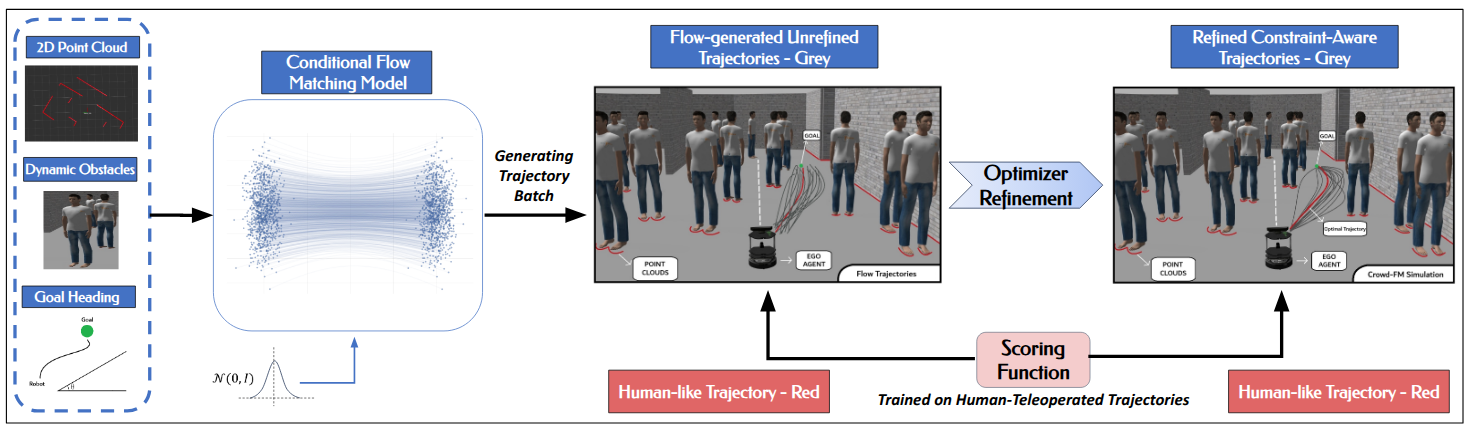
Safe and computationally efficient local planning for mobile robots in dense, unstructured human crowds remains a fundamental challenge. Moreover, ensuring that robot trajectories are similar to how a human moves will increase the acceptance of the robot in human environments. In this paper, we present Crowd-FM, a learning-based approach to address both safety and human-likeness challenges. Our approach has two novel components. First, we train a Conditional Flow-Matching (CFM) policy over a dataset of optimally controlled trajectories to learn a set of collision-free primitives that a robot can choose at any given scenario. The chosen optimal control solver can generate multi-modal collision-free trajectories, allowing the CFM policy to learn a diverse set of maneuvers. Secondly, we learn a score function over a dataset of human demonstration trajectories that provides a human-likeness score for the flow primitives. At inference time, computing the optimal trajectory requires selecting the one with the highest score. Our approach improves the state-of-the-art by showing that our CFM policy alone can produce collision-free navigation with a higher success rate than existing learning-based baselines. Furthermore, when augmented with inference-time refinement, our approach can outperform even expensive optimisation-based planning approaches. Finally, we validate that our scoring network can select trajectories closer to the expert data than a manually designed cost function.
@INPROCEEDINGS{11696381,
  author={Singha, Antareep and Nanwani, Laksh and Mathai, Mathew P. and Jain, Samkit and Singamaneni, Phani Teja and Singh, Arun Kumar and Krishna, K. Madhava},
  booktitle={2026 IEEE International Conference on Robotics and Automation (ICRA)},
  title={Crowd-FM: Learned Optimal Selection of Conditional Flow Matching-generated Trajectories for Crowd Navigation},
  year={2026},
  volume={},
  number={},
  pages={6573-6580},
  keywords={Modeling;Trajectory;Color;Fluid flow;Timing;Frequency modulation;Learning (artificial intelligence);Navigation;Costing;Costs},
  doi={10.1109/ICRA57385.2026.11696381}
}